Coin Show – BRNA This Week
Today’s post brought to you by:
For those interested, the Blue Ridge Numismatic Association’s coin show information is:
51st BRNA ANNUAL CONVENTION INFORMATION
The Blue Ridge Numismatic Association (BRNA) invites you to participate in its 51st Annual Convention.
Friday August 20 8 AM to dealers with tables General Public: 10 AM to 6 PM
Saturday August 21 8 AM to dealers with tables General Public: 10 AM to 6 PM
Sunday August 22 9 AM to dealers with tables General Public: 10 AM to 3 PM
Security: 24 hour Armed Security from Wednesday Noon thru Sunday 4 PM
The show is held in the Northwest Georgia Trade and Convention Center in Dalton Georgia. The convention center is just off I-75 at exit 333. From the center’s web site:
The Northwest Georgia Trade and Convention Center is easily accessible from either Chattanooga Metropolitan Airport (CHA) or Hartfield-Jackson Atlanta International Airport (ATL). The facility is 1/4 mile from Interstate 75 at exit 333 in historic Dalton, GA.
After exiting I-75 at Exit 333, turn West onto Walnut Avenue. Continue 1/4 mile up the hill and turn left into the convention center parking lot.
The show hosts roughly 200 tables with a wide variety of collectible and investment numismatics on display for buying, selling and trading.
To use a cliche, remember, “the early bird gets the worm.” The dealers will buy and sell throughout the three-day show. However, what they sell will be gone, and what they buy may not be on display. Arrive early to find the widest variety of numismatics to match your interests.
Today’s post brought to you by:
New $600 Requirement
Today’s post is brought to you by: GovMint.com-2010 Coins Now Available! Click here!
Have you heard about the new 1099 requirement for businesses that was hidden in the Health Care legislation?
In the past, businesses had to report payments to individuals, in lieu of W-2 forms, for services rendered in excess of $600 per year. Financial institutions, such as banks and stock brokerage firms, also used 1099 forms to report interest or dividends they paid to individuals during the taxable year.
Now, with this new law, businesses will have to report any payments over $600 for goods in addition to services. For example, this includes utility bills, telephone bills, office supplies and any other expenses that equate to $600 or more during the year.
You may have also heard on the news and in print that coin dealers are especially concerned about this new requirement. They frequently buy from and sell to many individuals and businesses throughout the year. The amounts per invididual or business frequently will be greater than $600 in the year to an individual or business.
Rather than belabor the point from the dealers’ perspective, let’s think about this from an individual collector and investor’s view.
To refresh your memory, this is what a 1099 looks like:
The gray arrows point to information about the payee. There must be a tax identification number. This can be a Social Security number or it can be a Tax Identification Number. Most individuals would only have a Social Security Number. In addition, the payee’s name and address must be on the form.
“What’s the big deal. This is the dealer’s problem not mine,” you’re thinking.
Are you sure?
What if you want to sell a coin or several coins? Maybe you want to upgrade your collection, cull out some of the lesser coins and use the funds to buy nicer specimens. Or, maybe you invested in gold or silver and want to translate some or all of it back into cash.
Anytime you sell any of your collection, the buyer (the dealer) will have to collect the information noted on the 1099 from you.
“Oh but, I’m only going to sell coins less than $600.”
But, how will the dealer know that you won’t sell him more at a later date within the same year for a total greater than $600? He doesn’t know. Therefore, he will need to maintain the paperwork for every purchase or face IRS penalties.
You’re still thinking, “OK, but this is still the dealer’s problem, not mine.”
Are you sure?
Anytime you provide your Social Security Number to someone, especially someone you don’t know or don’t know how trustworthy all of their employees are, you endanger your identity.
Identity theft causes many problems and takes significant time to correct.
This new requirement makes people vulnerable – especially numismatists and investors.
Criminals already focus on collectors with their various theft schemes. This new legislative reporting requirement gives these villains another avenue to explore and exploit for their nefarious plots.
The good news is that some legislators in both the House and the Senate are trying to repeal this requirement. However, they face stiff competition.
Several dealers are already discussing getting out of the business if this requirement is not repealed.
From a collector or investor’s view, you should let your representative and senator know that this requirement endangers your information and your hobby.
Today’s post is brought to you by: GovMint.com-2010 Coins Now Available! Click here!
Friday Metals
Today’s post brought to you by:
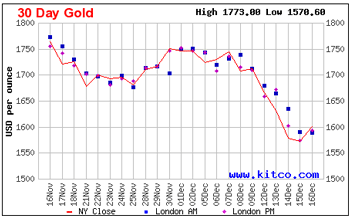
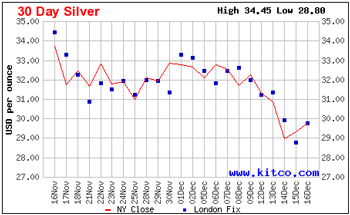
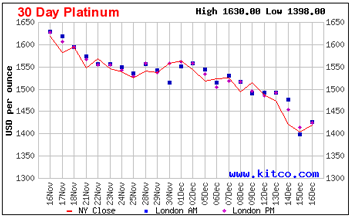
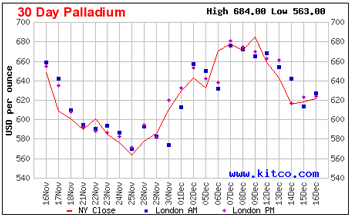
Interesting, the metals fell this week, but they quickly began climbing again. One commonly held opinion is that since options come due the third week of the month, the metals fall during that week. We’ll do a graphical study of historical third week performance in the near future.
But, for today, here’s gold:
Next, silver:
Third is platinum:
Fourth is palladium:
Now, what about the numerical performance of the 30 day lows and highs:
| 30 day high | 30 day low | Jun 25 Last | Difference between High and Low |
|
| Gold | $1,259.50 | $1,203.50 | $1,255.70 | 4.4% |
| Silver | $19.37 | $17.36 | $19.10 | 10.4% |
| Platinum | $1,605.00 | $1,495.00 | $1,569.00 | 6.9% |
| Palladium | $502.00 | $421.00 | $477.00 | 16.1% |
And, back to the point of third week performance, how does today’s New York close compare to last Friday’s:
| Jun 18 Last | Jun 25 Last | Percent Change | Dollar Change |
|
| Gold | $1,256.50 | $1,255.70 | -0.1% | -$0.80 |
| Silver | $19.17 | $19.10 | -0.4% | -$0.07 |
| Platinum | $1,589.00 | $1,569.00 | -1.3% | -$20.00 |
| Palladium | $488.00 | $477.00 | -2.3% | -$11.00 |
Just look, gold and silver almost climbed back to their levels of last Friday but not quite back to their recent highs of $1259.50 and $19.37 respectively. Platinum and palladium’s performances are too shabby, but since they do not get the same attention as gold and silver, they did not get as close to their values of last week. Remember, sometimes that lack of media attention also protects those metals’ values.
Wonder what next week’s performance charts will be – mountain climbers or ditch diggers….
Today’s post brought to you by:
The Friday Metals Re-cap
Today’s post brought to you by: GovMint.com-2010 Coins Now Available! Click here!
Another interesting week with the metals. Take a look at the charts. Isn’t it interesting that the metals did not follow similar paths?
Gold climbed to a new high but then dropped back. Silver did some climbing, dipping back and started upward again. The less notorious metals, platinum and palladium, decided to do some climbing with only minor dips during the week.
Let’s look at the end of the week charts showing the last 30 days’ performance.
First, there’s gold:
Next, let’s look at silver:
And, the white metal, platinum:
Then, there’s palladium:
But, what about the numbers? (Note: this information was pulled at roughly 6 pm Eastern time.)
| 30 day high | 30 day low | Jun 11 Last | Difference between High and Low |
|
| Gold | $1,248.00 | $1,177.00 | $1,227.50 | 5.7% |
| Silver | $19.64 | $17.36 | $18.22 | 11.6% |
| Platinum | $1,737.00 | $1,492.00 | $1,539.00 | 14.1% |
| Palladium | $543.00 | $415.00 | $447.00 | 23.6% |
How does the NY close today, 6/11, compare to the close last Friday, 6/4?
| Jun 04 Last | Jun 11 Last | Percent Change Increase(+) Decrease(-) |
|
| Gold | $1,220.00 | $1,227.50 | 0.6% |
| Silver | $17.41 | $18.22 | 4.7% |
| Platinum | $1,511.00 | $1,539.00 | 1.9% |
| Palladium | $425.00 | $447.00 | 5.2% |
In absolute dollars, platinum had the biggest Friday to Friday gain at $28, but palladium’s $22 gain represented the biggest percentage increase of the four metals at 5.2% during the week.
With the economic and political negativity, here and around the world, who knows what next week may bring.
But, the metals’ performance continues to be intriguing and interesting to watch.
Today’s post brought to you by: GovMint.com-2010 Coins Now Available! Click here!
Downhill Roller Coaster
Today’s post brought to you by:
Wow…does the pit of your stomach feel like you’ve just ridden a roller coaster down a steep hill?
Take a look at the 30 day metals’ charts below:
First, there’s gold:
Next, look at silver:
Then platinum:
Last, there’s palladium:
Now, let’s look at a table of the high and low figures for the month with the last trade (pulled around 6:00 pm) for today:
| 30 day high | 30 day low | May 21 Last | Difference between High and Low |
|
| Gold | $1,241.25 | $1,133.75 | $1,177.00 | 8.7% |
| Silver | $19.64 | $17.50 | $17.64 | 10.9% |
| Platinum | $1,752.00 | $1,510.00 | $1,505.00 | 14.1% |
| Palladium | $571.00 | $415.00 | $434.00 | 27.3% |
Perhaps that sinking feeling is justified, however investing in the metals cannot be an eyes-glued-to-the-market venture. Yes, you do need to keep aware of your investments, but reaction to market fluctuations should be done with caution.
Many dealers talk about their customers who buy high and sell low. That’s not the way to invest in the market. Ideally, you want to buy low and sell high – obviously.
But, if you buy at a peak number and panic-sell when the market hiccups, you will - at best - make only small profits and will most likely lose money.
Calm down, that pit of the stomach feeling will fade. This week’s political and economic news, both domestically and globally, influenced the markets dramatically – the metals, the stocks and the currencies.
If you look at the table above, the metals had started back upward with the exception of platinum which, in all likelihood, will as well.
And, you might want to do some research to determine if now is a good time to buy before the metals increase again. As the economics and the politics continue to tumble the metals could continue the roller coaster ride with as many uphills as downhills.
But, remember, no one’s crystal ball can accurately predict the future. There are many very educated people from whom you can learn much, but even the most widely knowledgeable cannot tell you what will happen with the markets – metals, stocks or currencies.
Today’s post brought to you by:
Rare Gold and Fingers
Today’s post brought to you by:
He’s done it again.
Several weeks ago, we talked about Glenn Beck using gold coins on his TV show and handling them without protection – either protective holders or gloves.
Congressman Anthony Weiner recently attacked Goldline and Glenn Beck saying that they use scare tactics to get people to buy gold.
That, of course, gave Glenn Beck another opportunity to bring out his gold coins. If he wants to handle his personal coins with his fingers and put damaging body oils and fingerprints on the coins, that’s his prerogative. But, unfortunately, his doing so will give those less educated about coins and numismatics the wrong idea.
You should NOT touch rare and/or valuable coins with your bare hands. The coins should be in protective holders. If they are not, then use white cotton gloves to hold the coins. And, those cotton gloves should be clean of any chemicals.
Glenn Beck can be scary in what he says and how he says it; however, many times his scary comments have correctly predicted future events.
Is he using scare tactics to get people to buy gold? Well, if he is, then a lot of other people in the investment industry, the gold industry and in the halls of economic education are also scary as they advocate buying gold when times – such as now – get financially rocky.
But, the Beck versus Weiner brouhaha is not the focus, the coins are.
Perhaps the coins Beck handles on his show are lower grade and their value is in the gold content not the coins themselves.
Still, many people watch his show and will deduce that it’s okay to handle any raw coins with bare fingers.
Not good, not good at all. At the very least, it makes all true numismatists cringe at the disrespect for the coins. At the worst, the coins decrease in value, and depending on their rarity and the damage caused by the bare fingers, the decrease in value could be significant.
Today’s post brought to you by:
Are you watching?
Today’s post brought to you by:
They’re doing it again. The metals, that is.
They’re climbing. Some say gold will be $1250 in third quarter. Others say gold could go to $1500. Of course, even the most savvy gold investors cannot predict with any certainty what the market will do.
In the meantime, let’s watch the climb.
Here’s the gold chart for this afternoon after the 4:00 pm close of the New York market.
Do you see that “May 11 Last 1231.70″ in the upper right of the chart? At $1231.70, gold exceeded its high in December 2009 of $1214.80. That high also happens to be the ten year high for gold.
What about silver?
Many people think silver is undervalued at the moment, but it, too, is climbing. In the upper right corner, the “May 11 Last 19.330″ is a new high for the last year. But, the five and ten year high for silver is $20.79 which occurred in 2008. If the upward trend continues – and many think it should, there will be new silver highs again soon.
The metals respond to turmoil domestically and globally. In this case, the financial issues in the European nations impact the prices of the metals.
Take a look at some of the financial articles for today:
Gold climbs as eurozone debt concerns resurface This article also shows an interesting quote from the Societe Generale, “Gold has recently proven an ability to escape from its traditionally negative correlation with the greenback as long as bullish drivers emanate from its safe-haven status or its perception as an asset of last resort, features it shares with the US currency.”
Investors Should Expect Higher Commodity Prices, JPMorgan Says A couple of interesting comments here. First, according to JPMorgan Chase, “The bank said it favors crude oil and industrial and precious metals.” They go on to quote the bank as saying, “Gold will average $1,250 an ounce in the third quarter, then $1,200 in the last three months of the year.” Now, how can they be so definite in their statement? There are many variables in the market, in the demand and in the global economy that cannot be readily predicted.
Gold Rises, Approaches Record on Haven Demand as Euro Declines This one includes scary comments about European banking, but it also reads, “The metal will trade at $1,250 to $1,350 by the end of the third quarter, said Tobias Merath, head of commodity research in the private banking unit of Credit Suisse Group AG.”
Gold Closes At Record High Amid Doubts Over EU Bailout Very simply, it states, “Investors’ search for a safe bet in times of crisis has pushed the price of bullion up 9% since the start of April, weakening its negative correlation with the dollar.”
Gold A Comfort In Chaotic Times Reflecting many investors, this article comments, “Gold’s role is to be there when investors want to buy a security blanket, and there to sell when they feel more comfortable to venture back into stocks.”
Gold Prices Close at All-Time High TheStreet.com starts their article, “Gold prices Tuesday made a new all-time high as investors bought gold as a safety net against worries that Europe’s financial aid plan wouldn’t be enough to save the euro.”
The metals should prove interesting to watch this week as the European financial news continues along with the changes in the political environments in several of the European nations.
Today’s post brought to you by:
A History Lesson – Gold & Friday
Today’s post brought to you by: Gold Eagles from GovMint! Get your GOLD NOW!
Black Friday, that is. Not today, but over 140 years ago there was a Black Friday, possibly the first, due to gold. Though instigated by two speculators, James Fisk and Jay Gould, President Ulysses S. Grant’s retaliation made the problem even worse.
During the Civil War, the US Government issued paper money that was not based on a gold standard. After the war, people generally thought the government would buy back the paper with gold.
At that time, federal holdings of gold were $95,000,000 with only $15,000,000 circulating around the country. As financiers and speculators, Mr. Fisk and Mr. Gould wanted to buy as much of the circulating gold as possible then watch the values rise.
Their plan would work only if President Grant kept the government gold. However, after the war President Grant did begin to buy back the paper money with gold.
With some arm twisting, figuratively speaking, the financiers used President Grant’s brother-in-law, Abel Rathbone Corbin, another financier, to gain access to the President at social functions. At every opportunity they presented their opinion that the government should keep its gold using Corbin as another voice in their argument.
President Grant continued to socialize with Mr. Fisk and Mr. Gould but remained undecided about the government’s gold position. To further their ends, the financiers convinced Corbin to influence President Grant in appointing General Daniel Butterfield as Assistant Treasurer. The Assistant Treasurer would be in charge of any sales of gold on Wall Street. After his appointment, Butterfield would keep Corbin and the other financiers informed prior to any government gold sales.
Many historians remember President Grant as gullible and lacking in leadership throughout his presidency. Gullible, yes, but in this case, the financiers perhaps approached President Grant a few too many times espousing their government gold ideas. In particular, President Grant became suspicious of his brother-in-law’s interest in gold.
This came to a head when President Grant’s sister, Abel Corbin’s wife, wrote a letter to Mrs. Grant about Corbin’s gold interests. President Grant realized the financiers including Corbin were manipulating him regarding gold.
Very quickly, President Grant sent an angry missive to his brother-in-law telling him to cease his gold efforts. Soon thereafter Grant ordered $4,000,000 of the government’s gold holdings to be sold on Wall Street.
In the meantime, Fisk and Gould had been buying gold and had been watching the price climb. On Friday, September 24, 1869, the price of gold rose to $162.50. People borrowed money to buy gold as the price crept upwards. But, when President Grant’s $4,000,000 in gold hit the market on that day, the prices fell sharply.
Take a look at this picture from the Library of Congress showing the black board of the Gold Exchange on Friday, September 24, 1869.
From the close on Thursday at 143 and 1/8 to a high of 162 and 1/2 on Friday, the price sharply dropped to what appears to be 33 and 3/8 on the black board.
People lost significant amounts of money; some investors lost everything.
As for Corbin, Gould and Fisk, Corbin lost big as did Fisk, however Gould sold much of his gold before the prices dropped.
In the subsequent Congressional hearings, Butterfield lost his position as Assistant Treasurer, but the people would not allow Virginia Corbin or Julia Grant to be questioned.
The manipulation by speculators and by President Grant caused Wall Street brokerage houses to fail, stocks to plummet, businesses to break down, and people’s lives and livelihoods to be devastated.
Perhaps this was the first occurrence of gold manipulation by speculators and by the government, but it raises a warning flag.
Today, many gold pundits say that governments, not just ours, are manipulating the gold market. Others say that the gold market is too big to be manipulated.
This is not an intentionally Negative Nellie article, instead it provides a lesson from history. Perhaps one should be open-minded in thinking about what governments and speculators can do to businesses and the marketplace.
Today’s post brought to you by: Gold Eagles from GovMint! Get your GOLD NOW!
Metals, how they shine!
Today’s post brought to you by:
It’s interesting to look at the metals and how they performed during the same time periods. The five year charts give an interesting history – not so long that the economy’s inflation is a hindrance and not so short that you can’t “see the forest for the trees.”
First, the gold roller coaster ride has been mostly up with the high in December 2009 at $1214.80, but recent increases have it at $1155 not too far away from its high:
Of course, silver continues to be a popular, and some say undervalued, metal. Silver’s high at $20.79 was in early 2008, but its current consistent performance of over $18 continues an upward climb.
Now, for some real fun, let’s take a look at the PGMs (Platinum Group Metals).
First, let’s review platinum since some coins are made using platinum. Platinum enjoyed a high of over $2200 in early 2008, and recent performance has it over $1727. It looks to be steadily climbing the mountain in the chart.
What about palladium? It’s difficult to mine, is found with the other PGMs but is not found in large quantities. It, too, had a high at $579 in early 2008, but look at it today. Palladium closed at $546 not quite but almost back to its 5-year high.
Another PGM, rhodium, has an interesting five year history. Back in 2008, rhodium experienced a high of over $10000. Now, in 2010, the prices are approaching $2800.
Had you owned one commodity of each of the above metals in early January 2009, the past fifteen months would have been very, very good to your investments.
Starting at the top:
Gold increased 35.5% since January 2009.
Silver grew 66%.
Platinum added 85.9%.
Palladium – the winner - enjoyed a 200% increase (means it tripled in value).
Rhodium’s growth came in second place with an increase of 180.2%.
Gold, it seems, receives the majority of the attention – due to once having been the currency standard and is still indirectly considered as such - but these other metals quietly outperform their golden cousin.
Just an interesting and fun way to view the metals!
Today’s post brought to you by:
Nickel Riddle
Today’s post brought to you by:
First, some history for today:
1923 – Firestone Tire and Rubber Co. starts production on the first commercial automobile balloon tire.
1792 – George Washington performs first presidential veto on an Apportionment Bill for the members of the House.
Last week, we talked about how the 2009 nickel coins (& dimes) are difficult to find and how the mint expects 2010 mintages to be low as well.
Here’s another riddle for the nickels.
Warehouse stockpiles of the nickel metal have recently decreased with an associated increase in the price per pound.
Will this supply and demand issue abate or will it become more of a problem at the time the US Mint needs more nickel metal?
Of related interest, in the US Mint’s 2009 Annual Report, they comment, “The compositions of five-cent, dime, quarter-dollar and half-dollar coins are codified by statute. Any authority to change the metal composition of these denominations requires legislative action.”
The US Mint already loses money on the nickel at lower base metal rates. If the nickel metal price remains high when demand increases for the five-cent coin could legislation be generated to change the metal content of the nickel coin?
It’s a question without an answer at this point.
In 2007, the cost to make a nickel coin was $0.095 equating to a loss of $0.045 per coin. The cost that year was almost double the income, $0.05, for each coin.
In 2008, the cost decreased to $0.088, thus a loss of $0.038 per coin. In 2009, the cost per coin was $0.061 or a loss of $0.011 per coin.
Part of this decrease in cost per coin was the decrease in the cost of the metal, however toward the end of their fiscal year, the US Mint saw the nickel price begin to rise again.
The lack of supply currently helps drive the price up. One of the main reasons for the lack of stockpile is due to the lack of demand. Several mines cut their production of nickel dramatically due to minimal marketplace need. Now, mines are increasing their production. On the other hand, the Chinese market is increasing its domestic demand for stainless steel – one of the main uses for the nickel metal.
So, will the supply and demand curve continue to yield higher rates per pound? Or, will the supply and demand level out to stabilize prices? And what does this mean for the 2010 and beyond nickel production by the US Mint?
Again, no answers are immediate, but the nickel bears watching.
Here are some reference articles and commentary:
Stainless Steel News and Nickel Prices
Kitco’s Base Metals site including nickel, copper and zinc.