In response to a recent post, Found Item: A Space Age Coin?, Mr. Michael Alexander sent us a Press Release for an international coin. This coin traveled into space and spent over five months at the international space station.
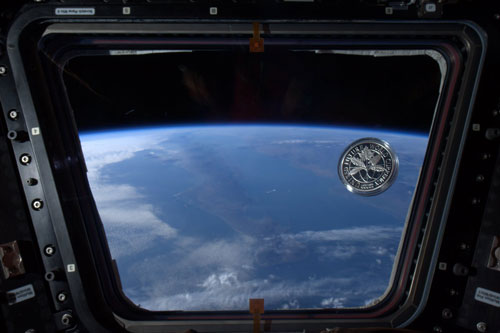
In front of one of the space station’s windows, the coin contrasts against the blue of earth:
The press release:
Boldly going where no coin has gone before…UFWC coin becomes first currency in space
The world and its diverse population were brought closer together above in the heavens & cosmos when two seemingly different programmes were united with just one spontaneous deed of goodwill. While both initiatives seek to unite the world’s population, one with the co-operation of the International Space Station, the other through a coin with the United Future World Currency’s (UFWC) initiative, there was one unusual turn of events with a difference. Both programmes came together when Paolo Nespoli, an Italian astronaut with the European Space Agency and chosen as one of the three person crew aboard the Soyuz TMA-20 which docked with the International Space Station packed a little something extra for the ride.
In the wake of NASA’s last ever mission of the Space Shuttle, It was recently revealed that Flight Engineer Nespoli brought along a 17 gram, silver prototype coin minted by the IPZS (Italian State Mint) in limited quantity for the UFWC ostensibly as a good luck charm. A silver example was given to Flight Engineer Nespoli by the UFWC’s founder, Dr. Sandro Sassoli shortly before his lift-off as a good luck charm. Mr. Nespoli confirmed to Dr. Sassoli at a recent reunion between the two that he had indeed taken the coin with him and as such, the coin accompanied him for the 159 day mission while he was a resident of the international Space station from December 2010 to May 2011.
Dr. Sassoli, founder and general coordinator of the UFWC initiative commented: “The aim of the International Space Station and of UFWC are actually one and the same, to link all countries and people of the world with the motto “Unity in diversity” further adding “I am so enthusiastic of this achievement of Paolo’s which though his good deed launches a message of real unity and brotherhood”
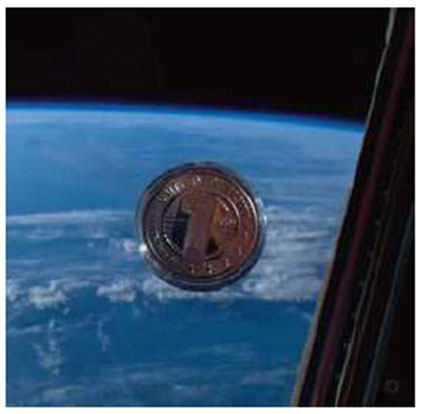
Flight Engineer Nespoli’s amazing photographs clearly show both sides of the encapsulated half ounce silver coin floating in zero-gravity space with the stunning backdrop of the earth providing a spectacular image. The coin’s legend, “UNITY IN DIVERSITY” is visible as well as the UFWC’s own “tree of Life” design. This event is of great interest for both coin collectors and space enthusiasts alike. Paolo has had quite a following regarding his experience aboard the International space station with his tweets and photographs. He is the one and only astro_paolo on Twitter.
Both versions of the 2009 dated first issue coins are eagerly sought by coin collectors due to the publicity surrounding their initial launch when Russian President Dimitry Medvedev’s enthusiastically endorsed the UFWC initiative in front of the world’s media. Further prototype coins have since been produced in several world mints including the Royal Mint in the UK, the Italian State Mint, and the Casa De Moneda in Mexico with several other projects planned for the remainder of 2011 and well into 2015 in time for “EXPO MILANO 2015”
EDITOR’S NOTES
The United Future World Currency (UFWC) was set up in 1996 as the initiative of Dr. Sandro Sassoli who has been the driving force behind the idea of this project for more than 15 years.
Dr. Sassoli began the UFWC initiative after a meeting and consultation with Prof. Arthur Schlesinger Jr., former counselor to US president John F. Kennedy.
The UFWC was originally begun with the patenting of the trademark “EURODOLLAR” by Dr. Sassoli before the formation of the European Union’s single currency, the EURO in 1997.
The first half ounce gold prototype coins struck by the UFWC were presented to the eight heads of state and government who attended the G-8 conference in L’aquila, Italy in July 2009.
The UFWC came to world-wide prominence and attention at the 2009 G-8 summit when Russian Federation President Dimitry Medvyedev endorsed the project by holding up his gold coin to the international media covering the summit.
The Soyuz TMA-20 lifted off on the 15th December 2010 from Baikonur, Kazakhstan with a three person crew consisting of Commander Dmitri Kondratyev, Flight Engineer Catherine Coleman and Flight Engineer Paolo Nespoli. The expedition ended on the 24th May 2011 after a 159 day mission.
First Engineer Nespoli “tweeted” his comments and images whilst on board the International Space Station. The UFWC coin images were among those sent back to the more than 49,000 followers.
The coin’s obverse design carries an illustration of the “tree of life” consisting of five leaves (representing the five inhabited continents) found on every continent. The Tree of life design is the work of engraver Laura Cretara, formerly chief engraver of the Italian State Mint.
The reverse design is the work of Luc Luycx, of the Royal Mint of Belgium. Luc also designed the present common reverse sides of the single EURO coinage struck in the EURO-zone since 1999.
The United Future World Currency produced the world’s first ever Eco-silver coin in 2011, minted purely from dedicated recycled silver, sourced and refined to a high grade of silver from scrap metal. Struck at the Royal Mint in the UK, the coin was launched at the World Money Fair in Berlin in January.
The coins of the UFWC have been given legal tender status at the forthcoming “EXPO MILANO 2015”. A special set of coins will be commissioned for this occasion and will be utilised for the duration of the International Exposition.
The coin given to Flight Engineer Paolo Nespoli was struck at the Instutito Poligrafico Zecca Dello Stato (The Italian State Mint) It is a 17.5 gram sterling silver proof quality collector’s coin.
The UFWC prototype coins, yet to be officially named, is currently organising a competition primarily involving young people to choose a name in time for the EXPO MILANO 2015 special set of circulation coins.
For more information about the United Future World Currency, please visit their dedicated website at: www.futureworldcurrency.com
For more information and images of the floating unity coin as well as Flight Engineer Paolo Nespoli, please contact Michael Alexander at: firsthand.pr@gmail.com
Flight Engineer Paolo Nespoli’s Twitter page can be found at: http://twitter.com/#!/astro_paolo
Two other pictures show the obverse first and then the reverse of the coin:

They also included their logo and credit to the Flight Engineer for taking the photos:

Is the world ready for a world currency?
Even in a stable economy, moving to one currency system would be difficult – not impossible, but very difficult. With the chaos in today’s global economy, moving to one currency just became improbable if not impossible.
But, you make your own decision as to the viability of one currency.
It could be interesting.